Tampilkan postingan dengan label alternatif energy. Tampilkan semua postingan

Jumat, 09 April 2010

Clean Tech Investments Soaring in 2010


Worldwide, investors put $1.9 billion into clean tech startups in the first three months of 2010. That is an 83% increase from the same quarter last year and a 29% increase from the fourth quarter of 2009. Additionally, the number of deals hit a record high.
Sheeraz Haji, president of Cleantech Group, says: “The bounce back in venture investment from lows in early 2009 has continued, with the first three months of 2010 representing the strongest start to a year we have ever recorded.”
The results come from a survey of investments made in 180 companies from North America, Europe, Israel, India, and China.
Electric car-related startups and solar technology startups received the most investment.
$704 million went to electric car-related startups, half of which went to one company — Better Place. Better Place is a Silicon Valley company that has signed contracts to build electric car charging stations and other infrastructure in Australia, California, Canada, Denmark, Hawaii and Israel.

FREE Solar Electric Vehicles! [PICS]


 There are large steps and small steps that can be made to reduce our greenhouse gas emissions and other pollution. I think these solar electric vehicles are something in between, but definitely something to start using!
The Solar Electric Vehicle Company creates innovative electric shuttles (i.e. large golf carts) for universities, resorts, stadiums, governments, shopping malls, airports, arenas, medical centers, etc. that combine electric vehicle (EV) technology with solar power technology. Looks like a good combination.
Not only that, but these vehicles are FREE!
As The Solar Electric Vehicle Company states, “Founded on the principles of national and community involvement, corporate responsibility, and most importantly, environmental responsibility, The Solar Electric Vehicle Company is dedicated to the Greening of America. Using an innovative business strategy and partnering with corporations committed to combating climate change and dependence on foreign oil, The Solar Electric Vehicle Company provides clean and reliable solar-electric shuttles to communities and institutions cost free.”

See More Article >

Sabtu, 13 Februari 2010

Circuit uses light to power itself


Scientists have created a circuit that can power itself, as long as it's left in a beam of sunshine.
Created by scientists from the University of Pennsylvania, the world's first photovoltaic circuit could eventually power a new line of consumer devices or even model the human brain.
"This has the potential to create a new generation of optical and electronic devices," says Dr Dawn Bonnell, a scientist from the University of Pennsylvania who co-authored a recent ACS Nano paper describing the research. "The touchscreen of your computer could act as both the electrical charger and the computer chip."
Bonnell and her colleagues can only coax minuscule amounts of electricity from their photovoltaic circuits, far too little to power consumer electrical devices. But those amounts could quickly skyrocket.
"We would have one amp with one volt in a sample the diameter of a human hair and an inch long," says Bonnell. "If the efficiency scaled up without any additional limits."
There are plenty of other ways Bonnell can squeeze more electricity from light. About 10% of the photovoltaic circuits on a glass side work. Increasing that number will boost the power output.
Yet another way to get more power is by turning their 2D structures into 3D structures. Stacking multiple layers of light-collecting and electricity-using circuits would also boost power.
The photovoltaic circuit developed by Bonnell and her colleagues is a scientific breakthrough, not a technological one. These new circuits will most likely never replace their silicon counterparts.

Jumat, 12 Februari 2010

Preparations for six AP1000s


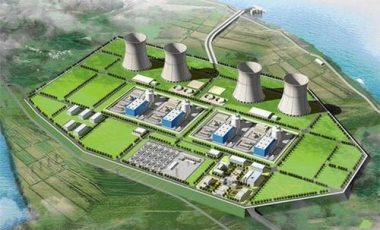
Chinese planners are moving ahead with three new nuclear power plants based on AP1000 reactors - the first to be developed after technology transfer from Westinghouse.

The US-based reactor vendor is already constructing pairs of AP1000 reactors in China with its partner Shaw at Sanmen and Haiyang, but these new units are to be the first built independently after the technology transfer that was part of Westinghouse's contract. They are also China's first nuclear power plants not located on the coast.

The sites are Xian'ning, Hubei province, Tauhuajing in Hunan, and Pengze in Jiangxi. All have been given the go-ahead for final design and initial construction work, such as site clearance, for the first two reactors at each site. Main construction is set to start on all three sites around this time next year, with commercial operation following around 2015.

A further wave of AP1000 build will include at least one other pair of units at each of the above sites, while up to six new locations are already pencilled in for AP1000 development.

Each of the latest sites is to be led by a different Chinese firm: Xian'ning by China Guangdong Nuclear Company; Taohuajing by China National Nuclear Company; and Pengze by China Power Investment Corporation. Transferral of the AP1000 technology is being carried out by State Nuclear Power Technology Corporation, which will now take the engineering lead on new AP1000s.

Nuclear production line

Having developed its own reactors and imported a wide range of units from international vendors, China is now focused on two designs for mass deployment: the CPR-1000, developed from French 900 MWe-class units imported in the late 1980s, and the AP1000.

According to plans, fleets of these reactors will be constructed with exponential speed for China to achieve a nuclear capacity of over 60 GWe by 2020 - and as much as 120-160 GWe by 2030. Such an achievement would make China by far the biggest generator of nuclear power in the world.

Successive CPR-1000 projects have featured increasing amounts of local engineering and now around 90% of plant components are sourced from Chinese firms. The AP1000 features modular construction and China has quickly set up specialised nuclear facilities to produce the very large modules - effectively creating a production line for nuclear power plants.

Selasa, 09 Februari 2010

Wow, China is serious about clean energy !


Wind Power

The world’s largest wind power project is currently in Texas (with a capacity of 782 MW), but China“is in the midst of building a wind corridor that could grow to a staggering 20,000 MW, 25 times the size of Texas’ Roscoe Wind Farm.” (emphasis mine) This wind farm in China is expected to have a capacity of 5,000 MW by the end of this year.

Solar Power

Additionally, China just “announced it would build a 2,000 MW solar thermal project, five times bigger than the current largest one, California’s Solar Energy Generating System.”
And in the fall, China announced plans to build a 2000 MW solar photovoltaic farm, “33 times bigger than the world’s largest today, a 60 MW farm in Spain.” (empasis mine)
Washington State thought it would take the world title with a planned 75 MW solar PV plant — think again. It may complete this plant before China’s, but don’t think that it will be the big news for long.
See article

Quote interesting response:

  • Europe has big wind ambitions too. Consider this ” link” and those projects are not with expected load factors under 20 but well above 30.  Almost 100 GW of off-shore wind projects are under consideration in the North and Baltic Seas alone. 1 GW (more) of off-shore windmills are to be connected to the grid in 2010 in europe.
  • .....a study by the Energy Foundation found that “Residential and commercial rooftop space in the U.S. could accommodate up to 710,000 MW of solar electric power,” which is 75% of the nation’s current electric consumption.  
  • You left out China’s biggest source of new clean power:   “Additional reactors are planned, including some of the world’s most advanced, to give a sixfold increase in nuclear capacity to at least 60 GWe or possibly more by 2020, and then a further substantial increase to 160 GWe by 2030.”    And a watt of nuclear capacity is worth about three of wind or solar.

    Sabtu, 12 Desember 2009

    Fuel Cells


    Energy Source of the Future

    According to many experts, we may soon find ourselves using fuel cells to generate electrical power for all sorts of devices we use every day. A fuel cell is a device that uses a source of fuel, such as hydrogen, and an oxidant to create electricity from an electrochemical process.

    Much like the batteries that are found under the hoods of automobiles or in flashlights, a fuel cell converts chemical energy to electrical energy.

    All fuel cells have the same basic configuration; an electrolyte and two electrodes. But there are different types of fuel cells, based mainly on what kind of electrolyte they use.

    Many combinations of fuel and oxidant are also possible. The fuel could be diesel or methanol, while air, chlorine, or chlorine dioxide may serve as oxidants. Most fuel cells in use today, however, use hydrogen and oxygen as the chemicals.

    Fuel cells have three main applications: transportation, portable uses, and stationary installations.

    In the future, fuel cells could power our cars, with hydrogen replacing the petroleum fuel that is used in most vehicles today. Many vehicle manufacturers are actively researching and developing transportation fuel cell technologies.

    Stationary fuel cells are the largest, most powerful fuel cells. They are designed to provide a clean, reliable source of on-site power to hospitals, banks, airports, military bases, schools, and homes.

    Fuel cells can power almost any portable device or machine that uses batteries. Unlike a typical battery, which eventually goes dead, a fuel cell continues to produce energy as long as fuel and oxidant are supplied. Laptop computers, cellular phones, video recorders, and hearing aids could be powered by portable fuel cells.

    Fuel cells have strong benefits over conventional combustion-based technologies currently used in many power plants and cars. They produce much smaller quantities of greenhouse gases and none of the air pollutants that create smog and cause health problems. If pure hydrogen is used as a fuel, fuel cells emit only heat and water as a byproduct. Hydrogen-powered fuel cells are also far more energy efficient than traditional combustion technologies.

    The biggest hurdle for fuel cells today is cost. Fuel cells cannot yet compete economically with more traditional energy technologies, though rapid technical advances are being made. Although hydrogen is the most abundant element in the universe, it is difficult to store and distribute. Canisters of pure hydrogen are readily available from hydrogen producers, but as of now, you can't just fill up with hydrogen at a local gas station.

    Many people do have access to natural gas or propane tanks at their houses, however, so it is likely that these fuels will be used to power future home fuel cells. Methanol, a liquid fuel, is easily transportable, like gasoline, and could be used in automobile fuel cells. However, also like gasoline, methanol produces polluting carbon dioxide.


    More About Fuel Cells and Energy

    Video: Fuel Cells
    Video: Alternative Energy
    Video: Energy Conservation
    Article: Future Power: Where Will the World Get Its Next Energy Fix?
    Quiz: Energy

    AEoogle Search

    AEoogle